Episode Transcript
[00:00:00] Speaker A: Foreign.
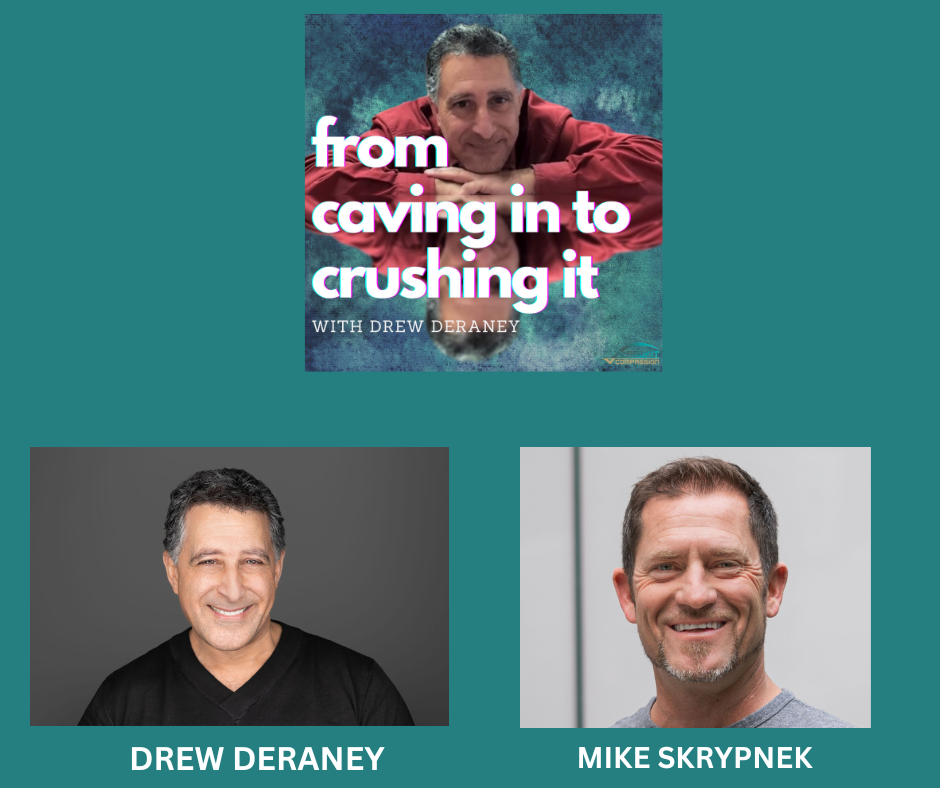
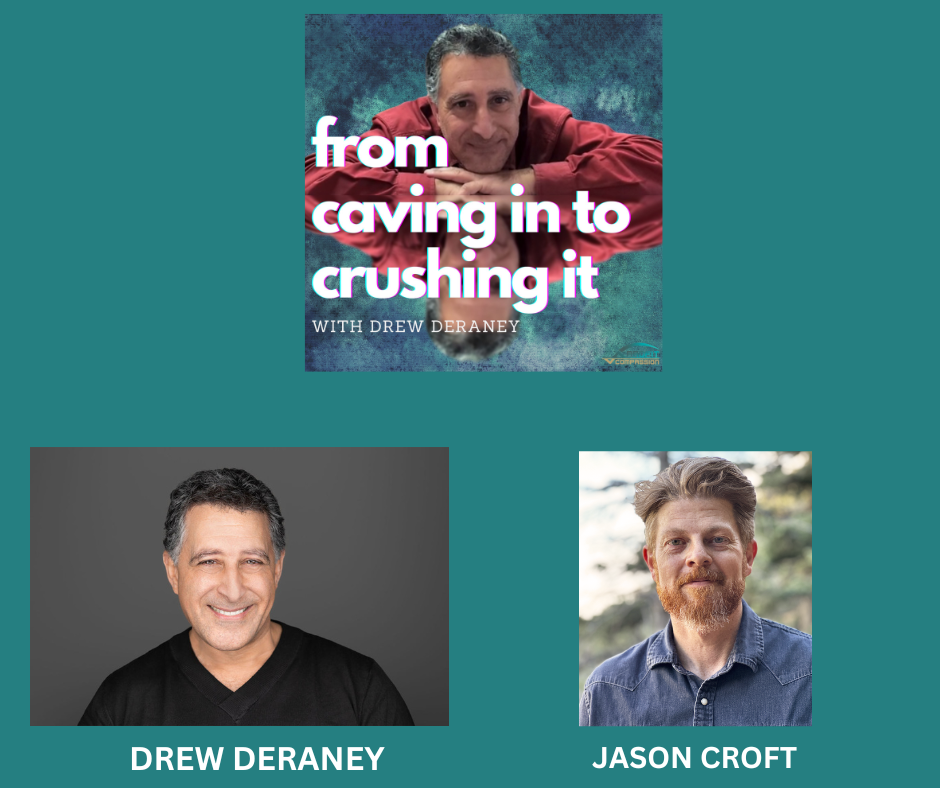
The podcast for those who find themselves immersed in adversity and choose to write their story instead of having others write it for them. I'm Drew Duraney and I'm your host.
Mike Skripnik is the founder of the Unlimited Worth Project and Unlimited Worth Wellness Society. He is a business strategist, leadership expert, nine time international, number one best selling author, keynote speaker and a men's Wellness, Men's Mental wellness advocate.
Mike is an executive leadership expert and strategist helping entrepreneurs and industry leaders with a gift for normalizing narratives so people can share their challenges and identify ways to overcome their limitations.
Often what holds us back is what happened to us as we grew up. Negative events that caused trauma in life, embedded patterns or instincts that were designed to protect us.
In our modern world, these protections often held us back. In doing so, they constrain our families, relationships and work. Almost everyone has lived under toxic stress. At some point, many people feel they are living below their potential.
Mike shows you ways to gain insight needed to develop the awareness to overcome any limitation keeping you from your own personal or professional success.
Mike is an international best seller of nine books, a keynote speaker, men's mental health advocate and corporate wellness trainer. He is a sought after business strategist who has shared his insights and wisdom with thousands of passionate, purpose driven entrepreneurs, business leaders and executives. His coaching focuses on purpose at the intersection of personal, professional and philanthropic development.
Enjoy the show. Mike Skripnack, it's so good to see you.
[00:02:03] Speaker B: Hey Drew, how are you today?
[00:02:05] Speaker A: I'm doing well, thank you. And I have to thank you for getting up early. I know you're in, you're on the the west coast over in Canada.
So you're 7am and we're 10am Eastern Time here in New Jersey. So I do appreciate you making time for us and thanks for coming on.
[00:02:23] Speaker B: Yeah, thank you for having me.
[00:02:25] Speaker A: It's my pleasure. So I always like to thank the person who introduced me to my guest. So Jennifer regular, you get a a shout out. So thank you so much for introducing me to Mike.
I certainly know why you did so. I appreciate that.
So my audience knows that in the beginning I always talk about how we're taught when we're young that life is linear. It's a straight line that if we do A plus B plus C D is going to happen and it's not a malicious thinking. They wish it for us, they hope it for us, they pray it for us. And for the most part life is linear until it's not ultimately an external circumstance. Will get in the way of one of those letters and create that more circuitous root.
And that, you know, when. When something gets in between those letters, obviously we call it adversity. And we either see the adversity or we don't see the adversity. And if we do see it, we have a choice to take it head on or to move, walk away from it or back away from it. And with that, I believe there's three types of men.
The man who doesn't see it in man number one. Man number one's got a ton of blind spots.
He doesn't see the adversity. He's living life the way he was told to live it. He's on autopilot, and he doesn't change a thing in his life. I don't have man number one on this show.
Then you have man number two. Now man number two sees the adversity, yet he considers the adversity a barrier, not an opportunity. He says, I'm the victim. Everything else is to blame. I can't change life. Life's doing this to me, and I don't change anything. It is what it is. And on his deathbed, man number two's got a ton of regrets. And I don't bring man number two on the show. I bring man number three on this show. Like Mike Skripnack, man number three has a heightened self awareness. He sees the adversity, and he says, I'm sick and tired of being sick and tired. That adversity is not a barrier. It's an opportunity to do something different, Take massive action and become a stronger man on the other side.
So with that, Mike, let us know as far. Go back as far as you need to for that defining moment in life. Whether it was that tap on the shoulder, the whisper in the ear, or like what I needed, the two by four upside my head.
I kind of transformed you from the man you were, whether it was one, two, or both, to the man you are today and how that transformation impacted you personally and professionally.
[00:04:52] Speaker B: Drew, it's. It's kind of interesting.
I would say there are two distinct points. There was a point where I. I had a linear view of life, but that was unfettered, unlimited, you know, nothing but potential. And I saw my future in, you know, technicolor, and I was 11 years old, right?
And a. A major incident occurred around that point that derailed it. And then man number two kind of began to exist in all the glory of all the barriers.
Only it wasn't barriers that he Ignored it was barriers he didn't see. And I'll explain that maybe later as well. And then there was the life altering moment, which almost was life removing, unfortunately four years ago.
And that incident is truly what helped me level up as a human being.
Although, you know, from a distance, from the outside looking in, anyone might say, oh, he's, he's been doing amazing.
And, and yet no one knew. And so the period of time in September of 2021, falling after 18 months of my business basically slowly but surely collapsing in on itself.
The pressures of finance and just isolation that was as a result of the pandemic, kind of weighed in heavier than I could bear. And for 10 days during that period of time in, you know, we're currently in a, in an absolute downpour season, it's raining like crazy. It was raining like crazy back then.
And every day I would walk, I would fake it on a zoom call, get through that call or two, I would hit the couch or hit my bed or go out for a walk. And for 10 days, starting with one key day when I looked into the river that was raging and I said, you know, today's the day I'll do this. The day's the day I throw myself in. Today is the day my worries and stresses all go away.
And I did that walk for 10 days.
And that walk, you know, didn't change other than I would come home and make a few notches on my pros and cons list, double check my insurance and consider whether or not the next day would be the day. And in my own way, I pushed the decision to make a final decision off until another day.
And then one day my wife had come home from her work and she reflected that she was worried about me. And I said, I, I was definitely having challenges and I hadn't told her. And I, I did this walk on my own.
And she was concerned because she was worried that the next day she would show up, that I wouldn't be there. And she, we hadn't discussed this.
[00:07:48] Speaker A: Oh, wow.
[00:07:49] Speaker B: And so I took that moment and that in that point in time and, and made an outreach to someone I knew that could help, that was a psychologist and a great friend.
And you know, you mentioned getting hit upside the head with a stick. Well, this was a wonderful woman who was part of my life for a very long time and we had a great relationship. And between the care and the love that a person close to you would provide, she also threw me a life preserver. But it wasn't just flotation. Device, it was hit upside the head with that life preserver. And so thus began my trajectory out of that moment.
And I had to realize and reconcile why I was there, what got me to that moment, that there was no way I would ever want to go back. But how do I fix it? How do I dig in to find out what it was that got me into that moment in the first place? Because it sure wasn't just another financial period or it wasn't just isolation. I'd been through all kind. I mean I was in the investment business for 20 years. Years. And then coaching for another almost decade by that point.
And you know, it certainly I'd lost a lot of money. I made a lot of money, I did a lot. Right. And, and those moments didn't seem to crush me. So what was it about this? And so I dug in to understand that over stressor and it all came back to that 11 year old boy.
[00:09:16] Speaker A: Tell us a little more about that 11 year old boy.
And, and the parallels between the 11 year old boy and, and who you were at the time you were looking in that raging river.
[00:09:28] Speaker B: That's funny.
At 10, 11 years old, somewhere in there.
I don't know what that was with grade five, grade six.
And you know, I had been, it was probably grade six and I was, my, my parents had someone come in and do a test and you know, because they were wondering where, you know, my middle school would be.
And you know, I, I didn't talk about this much but they, I was selected for a gifted school.
[00:09:54] Speaker A: Oh wow.
[00:09:55] Speaker B: And yet my parents had little means financially. And my, my mom had a definite belief that that may not provide me the social surroundings that I might need when opportunities is very athletic, very busy, very engaged.
And yet she was concerned that maybe that would be an isolating place where people who don't actually develop their full selves, they just develop the gift or whatever that is.
[00:10:23] Speaker A: Yeah.
[00:10:24] Speaker B: So it was that where also though the sky was the limit, there was. Everything was possible and, and I, and, and I excelled at everything at that point. And you know, who knew what lied in store.
[00:10:37] Speaker A: Right.
[00:10:37] Speaker B: And then there was a moment where I was involved in a, in a choir and I was selected for a soloist role. You know, at that point in my life I think I wanted to be a doctor more than anything.
[00:10:51] Speaker A: Right.
[00:10:52] Speaker B: And, and I was selected for a soulless role. And the man who led the choir, who led the community, who led the boys, who people handed their kids off to, abused me and he was abusing other people for years and it was that moment that somehow embedded itself. I mean you would imagine that that would be a traumatic thing, but it was something that was also buried by that 11 year old boy for another eight or nine years. Not to think about, not to discuss, not to even have on the surface that.
But it was the kind of incident that created some wiring that became part of my subconscious and my behaviors and the patterns I lived through my life.
That fast forwarding 40 years into a moment where you go, how did I get here? How, how did. And you look back and you go, my goodness. I repeated these kind of basic multi year periods of time in my life and then it was transition and restarted. And I had to figure that out. I had to understand what was it about that moment, even though I put it out of my mind. And any, anyone would, who didn't know because it was a secret as well. So it was eating me alive. Right.
Would otherwise say, man, if you, if they knew, they would go, that guy's a success, like he's overcome something. But the reality was I never dealt with something right. And it was just chewing away at my potential.
And you know, in a sense it created this cap, this limit. So no, no matter what it seemed, I was destined to re. Recreate instances or, or, or patterns of, of living.
And those patterns created challenges for me very simply. So there I was, 51. I'm starting to dig into this. I'm looking.
[00:12:41] Speaker A: That's important.
[00:12:41] Speaker B: Yeah, yeah, I'm looking like what's going on?
And in that, in that moment I realized that what it was was a number of things that were designed to protect that kid.
And those things that are instincts that get wired into us to preserve our lives so that we can provide and procreate and do what our DNA wants us to do. Ultimately, you know, those things are very powerful in their subconscious. They're not designed to be in our consciousness because if we thought too much about the snake in front of us, we'd probably end up dead.
[00:13:16] Speaker A: Right.
[00:13:16] Speaker B: And, and so what were these things? And one of them was never trust a good man because it was the pillar of the community.
[00:13:23] Speaker A: Right, right.
[00:13:24] Speaker B: Who abused me. And that had been subconsciously wired and thus somehow thwarted relationships with men over my lifetime in ways that I never understood. Sometimes it was creating a conflict that didn't really exist or repelling somebody that I really wish I would be able to work with or would mentor me.
[00:13:48] Speaker A: Right.
[00:13:49] Speaker B: But then being attracted to men who I could see that they were flawed, that they weren't the best guys in the room. But, you know, I could manage that somehow.
And when they, you know, hit the.
[00:14:00] Speaker A: Wall.
[00:14:03] Speaker B: When it hit the fan, those men's flaws were bigger than all of us. And I was so close. I'd always go down with their ship, if you will. And thus, another transition, another loss, another financial loss, and whatever it was. And so it accumulated over a lifetime. And there I was digging in and going, oh, my gosh, this is. This exists.
And the work that I did suddenly brought it to the consciousness of my mind, and it just vanished. And it was no longer part of my limitations, of the potential that I. I had. And I never seemed to realize.
And when I became free or unshackled of opened up unlimited worth or unlimited potential. And I've been living in that unlimited, unlimited space ever since.
[00:14:58] Speaker A: That's wonderful. Did you ever tell anybody what happened?
[00:15:02] Speaker B: I. I had. At one point, I was 19.
[00:15:05] Speaker A: Yeah.
[00:15:06] Speaker B: I was in university.
I was having some challenges with a girlfriend. Yeah. And I said, you know, it's me. Not you. Must be me. And I went and saw a counselor.
[00:15:16] Speaker A: Okay.
[00:15:17] Speaker B: And I went to a university counselor, and that counselor looked at me or did whatever they did with. With you at the time, and they said, you know, we can't go back and get the guy. Like, there's a statute on this. At the time, you know, eight years seemed like an eternity within the 80s.
And.
And yet you seem okay. You've got great grades, you're socially adjusted. You. You know, by all accounts, you're looking good.
So, you know, we don't think there's much we can do for you.
So I packaged it up, wrapped it in a little bow. Yeah. And buried it and continued on. And for me, it was, you know, part of the experience was that I learned to be independent. I didn't count on anybody. I didn't rely on other people. I became fiercely independent and would just charge ahead.
And it was easy for me to put bad experiences behind me because that's what I did initially.
[00:16:13] Speaker A: Right.
[00:16:13] Speaker B: Is so. So I could plow forward and drive my business or drive my aspirations in any direction, but I drive, I drove hard.
You know, and. And between relationships and alcohol, I would dump. Numb it. And between working and being extreme and working out and. And pursuing goals, all those things combined to sedate the feelings of. Of guilt and shame I had. But those weren't conscious. None of that was a conscious thing.
[00:16:42] Speaker A: Right.
[00:16:43] Speaker B: You know, and so my early twenties were.
Were kind of, you know, invested in, you know, anything I could do to just move forward.
[00:16:53] Speaker A: So that relationship, did that get better or did that not get better after the seeing the, the, the therapist at the school?
[00:17:03] Speaker B: You know, it went as your early year relationships do go. You know, it, it ran its natural course. We were, you know, the, the introspection was probably a lot more. Because we weren't compatible, you know, to that point in the first place. So the irritation was. There was a disconnect anyways, but at least it got me going. But so looking back, and as a 51 year old man back, you know, four years ago, and now I'm in my mid-50s, right. And I'm going, how do I help men? How do I help men recognize these things? How do I bring these things to light? Because it doesn't necessarily have to be an elephant in the room incident.
[00:17:40] Speaker A: Right.
[00:17:40] Speaker B: It can be other forms of innocuous seeming events and, and, but yet they wire themselves into our brains so that we behave a certain way to again, provide, protect, procreate, move on, you know, and I had an opportunity where no one around me understood the gravity of the situation and thus no one gave me a path to heal.
[00:18:07] Speaker A: Right.
[00:18:07] Speaker B: And I suggest that maybe I didn't need to get to the walk of despair for 10 days, considering ending my life, leaving my wife, leaving my family.
[00:18:18] Speaker A: Right.
[00:18:18] Speaker B: Leaving my trauma on the backs and burden of everybody else. Right?
[00:18:24] Speaker A: Right.
[00:18:24] Speaker B: Maybe we could do this while we're, you know, in a, in a typical setting where we're not overly stressed, but we're being introspective and we can go, we can, we can fix this. We can fix this and remove all those limitations that you think you have, that you perceive exist, that for some reason you keep knocking your head against a wall somewhere, either relationship, personal, professional, that you can actually go in and, and navigate your brain in a way that you can change that pattern.
[00:18:57] Speaker A: Right.
[00:18:57] Speaker B: And remove them from.
[00:18:59] Speaker A: You don't have to do it alone. No, you don't.
[00:19:01] Speaker B: You don't have to.
[00:19:02] Speaker A: Right. You don't have, you know, thank goodness your wife just sensed something and felt strong enough to reach out, to reach out to you and let you know what she was feeling. She gave you some vulnerability there that you could have just buried it, but you acknowledged you were going through some stuff. So it's great to have a partner who, who can, you know, have that intuition and then actually call you on it and you be comfortable enough to say, yeah, I'm going through some stuff.
[00:19:33] Speaker B: Yeah. Drew, you work with, it's, it's, you know, your platform is about caregivers, right. And you Know, as a, as a male, as a, as a provider, as the person who had the larger paycheck and the, and, and the bigger impact financially. You know, I felt that I had a big responsibility to protect and it was being put in jeopardy by all the situations. And so therefore that protect and provide, nurture kind of thing that I had going on, you know, was that in jeopardy. And so I was at my weakest and my most vulnerable. And my wife was a person who did know my secret.
She's the only one of the only person people in the world.
And you know, but she didn't understand the gravity of it.
[00:20:17] Speaker A: Right.
[00:20:17] Speaker B: And when we discussed it, we agreed that it's probably the thing that I should dig into first.
[00:20:23] Speaker A: Right.
[00:20:24] Speaker B: And I couldn't have moved forward without those moments where I knew my wife, my one person who I loved and trusted, that more than anything in the world, that I could have the confidence to share that vulnerability. And we all need to identify who that person might be. Because to step forward, it's one thing for the moment, a man says, I think I have a challenge. That's the five alarm fire. It's not I thinking about throwing myself in the river, right. It's, I think I'm struggling with something like that's the time. Because a man wants to talk at that moment, he just doesn't understand if the risk is too great with the person he's just about to share with. So if we find that person in our lives, we suddenly have that moment to give up that, that concern, that view that we have of risk.
And for me, that began a process of then leading to a person or professional that I trusted who wasn't the person who gave, who provided the therapy. Quite frankly, it was a different person. It wasn't the person that could help me at the moment was the right person, but she was the wrong person to work through the therapy part.
[00:21:30] Speaker A: Right.
[00:21:31] Speaker B: I needed a young man. I needed a man who I could trust, a good man, and someone to navigate that with me. And I found a young, you know, young mid-30s man, you know, who could help. And so an interesting dynamic though that was going on at the time, Drew, was when we talk about caregivers was a dynamic at home. We all were challenged by the pandemic, no question. Of course, our son had been in his first year racing downhill mountain bikes in Europe for World cup during that period.
[00:22:07] Speaker A: Geez.
[00:22:08] Speaker B: And so he was an elite athlete at the highest level in his first year ever in a rookie season.
[00:22:14] Speaker A: Wow.
[00:22:14] Speaker B: And I had gone with him earlier that year to Europe for five glorious weeks. And that was in June. And by September I was at home trying to figure out my, how to pay for him to get back from Europe.
We were coming up with capital to, to pay for the flights and whatever travel needs he had.
And he was entering Grade 12 at the time and considering what he's going to do for university. And so he had, and prior to my challenge, he had had a massive crash. Oh no. And so he's in Italy in August, recovering in the hospital from a crash that was viral on, on video.
And we could do nothing. And so he came back with a very different outlook in terms of he was troubled about where maybe he could go, how alone he, he felt.
And, and my, my son comes into this environment so focused on what he's going to do for school and he breaking up with a girlfriend that. And there I was, completely paralyzed in my own life.
[00:23:14] Speaker A: Wow.
[00:23:15] Speaker B: And so we had an interesting dynamic where he needed me, but he was so preoccupied and I needed him, but I was not there.
And while I shared what was going on with my wife, while I shared with the therapist, while I even had a chance to talk to our older daughter about this, there was my son.
He did not know and he did not care, to be honest. He was busy.
[00:23:40] Speaker A: And it was not malicious either. He was wrapped up.
[00:23:42] Speaker B: No, no, no. He was, he was wrapped up in his thing. And I, you know, and I, and I was, I was there, but I wasn't, you know.
[00:23:49] Speaker A: Yeah.
[00:23:50] Speaker B: And it took me three weeks longer to have a conversation with him and go into his room and say, you know, to our son. I said, son, you know, this is what I'm going through and this is what was going on with me and this is why. And I shared with him. Yeah. My secret. I said, this is what happened to me.
[00:24:10] Speaker A: Yeah.
[00:24:10] Speaker B: And because I wanted to learn if he had had any. You know, as a parent, you're always like, did it ever happen to you? Or you know, those.
[00:24:19] Speaker A: Yes.
[00:24:19] Speaker B: And I was relieved to know that that wasn't his life experience, you know.
[00:24:23] Speaker A: Good.
[00:24:24] Speaker B: And I was worried as a man would be telling his at the time, 17 year old son, you know, that, you know, this happened to me.
[00:24:33] Speaker A: Yeah.
[00:24:34] Speaker B: And you don't want to tell your son you were raped, you know, it's not your thing.
[00:24:37] Speaker A: No.
[00:24:38] Speaker B: And yeah, he looked at me and he, you know, he just said, I, I got you. You know, holy crap. Five years later, I'm still, four years later, I tear up about this stuff.
But that's what it means to give care is. And in. In a man's lens, when we know the people closest to us or somebody in our lives has our back unconditionally, then we can heal.
[00:25:07] Speaker A: Yes. 100.
[00:25:09] Speaker B: Yeah. And I make that a point. I have something called Men with Mentoring, which is a mentorship and coaching program.
[00:25:15] Speaker A: Okay.
[00:25:16] Speaker B: And in my life, I. I was always. I've always been a coach, but I never really understood a certain aspect of it. And so until this crisis, I was a great coach who could give a lot of input and.
And support people and help people be vulnerable, but I was never vulnerable.
[00:25:34] Speaker A: Right.
[00:25:35] Speaker B: And I didn't understand the connection. And. And since that time, it's elevated my coaching and my involvement with people that truly, when I enter a relationship with anybody, professionally or personally, I don't take the idea that I've got their back lightly. I make sure that they know it. And because it's the thing that can move us forward when we feel that we always have a fallback. Yeah.
Us guys can. Can figure out, we can take some vulnerability and put it on the table and say, here, this is. I'm laid bare.
You know, now I feel that I've got someone who's got me. I can move forward. And so when I consider how I give care to others, that's a key element, is letting them know and living it, not just saying it. Lip service about having someone's back. Like so many people say, I got you or I got your back. They don't mean it. They really mean. Until it's inconvenient for me, I'm not gonna. I've got you.
[00:26:33] Speaker A: Right, right, right, right.
[00:26:35] Speaker B: I don't mean it that way.
When it's inconvenient is probably when I'll be there the most.
[00:26:40] Speaker A: Yeah, that's. I mean, they. They believe it when they say it. And then when push comes to shove. Yeah. A lot of people don't stick around.
I love the name of your. The project, the Unlimited Worth Project. And does. Did you get that from stemming back from that child who had unlimited potential, looking at those. The gift school and all that.
[00:27:01] Speaker B: Yeah. I mean, when. When a man is on his knees.
[00:27:04] Speaker A: Yeah.
[00:27:05] Speaker B: We feel worthless.
I felt useless, hopeless. Like one of the reasons I didn't throw myself in the river, because I would fail at it. I probably would live, you know, and I didn't want to be another failure again. I couldn't fail at that.
[00:27:18] Speaker A: Right.
[00:27:19] Speaker B: So that sense of worthlessness in those moments and limitation that you're continually butting up against and you know it. You just can't put your finger on it.
I was standing here in our, in a front room of our house, trying to figure out what I would call what I was going to do next.
[00:27:36] Speaker A: Right.
[00:27:36] Speaker B: And, and it came up, you know, un. I felt unworthy.
And what I realized was all of my worth to trust that I'll be okay and I'm worthy to, to start. And, and, and, and that was key. And then the, the removal of these patterns in this and digging in created this sense of a lifting of all of that. And so I felt unlimited in my worth and unlimited worth then became the thing.
[00:28:04] Speaker A: You know, it may sound weird, but it, it's, it's, it's like the limitation you put on yourself because of the fear of failure kind of saved your life.
[00:28:16] Speaker B: Certainly. Like there's three things. Like I looked at my family and I said I can't do that.
[00:28:21] Speaker A: All right, well that. Good. Let's put the emphasis on that. But it's kind of interesting that, that.
[00:28:25] Speaker B: Yeah, but there's also an optimist in me. I still had this glimmer of hope like that at the end of the tunnel. It wasn't a train. It was like the sun. And I thought at least the sun will beat at the end of the. Yeah. Tunnel. So. But the, but the fear of failing at the, at the worst possible thing.
[00:28:42] Speaker A: Right.
[00:28:42] Speaker B: You can imagine at the time.
Yeah, that kept me, that kept me from doing it.
[00:28:48] Speaker A: All right. Hey, you know, you're here and, and thank God you're here. Tell us a little about how you're. How you.
Let's give me the, the a great feel good story of, of how you helped one of your clients, your male clients.
[00:29:05] Speaker B: So even though I came up, it felt like I was in the right groove with unlimited worth. And I, and I was quick to write a book and start a podcast and really get behind it.
[00:29:16] Speaker A: Right.
[00:29:17] Speaker B: It's been a few years of mid taking contracts and being distracted from the project itself and being all in. And I was kind of in on the periphery.
And only this fall was I clear to be able to, to really say, well, I'm in. I'm just. There's no other path for me but to be all in.
And I was trying to figure out what it is that connects that with what I was doing. And it's this term to transform lives through tangible actions. I think what I witnessed over the last few years is all these well intentioned people are just part of the noise and they're actually not changing Lives when they get in contact with.
[00:29:58] Speaker A: Right.
[00:29:59] Speaker B: And so how do I do that? Well, part of my mentorship and coaching, part of psychological first aid training, and part of peer support, commercial level peer support work that we do that changes lives, and it changes lives of either the person giving care or the person receiving it. And it does it in the moment.
[00:30:18] Speaker A: Right, right, right.
[00:30:19] Speaker B: I have these young men that I put into my subsidized version. It's a pay it forward version of coaching that. That is an executive coaching, but for very affordable access.
[00:30:30] Speaker A: Right.
[00:30:31] Speaker B: And these young guys are part of their partners in a business, and, you know, they're just on the precipice of making it, but they're struggling so hard. And I would. The place we live is one of the most expensive places in the planet. Like, our cost of living is crazy high.
And they're struggling with young families. You know, they're just ready to abandon it at any moment. And the pressure is killing them. Them. And I've been going through this process of coaching with them, and we had a moment where one decided that he was done.
[00:31:04] Speaker A: Oh, wow.
[00:31:05] Speaker B: And he's just throwing in the towel. They couldn't agree. He was struggling. And. And so we had to dig in. And so we've had many, many com conversations that are poignant and straight to the point. And there's no risk for him.
[00:31:18] Speaker A: He's.
[00:31:18] Speaker B: He can be as vulnerable as he wants and he gets a path of recommendation or suggestion. And yet they were still struggling. And we had this group meeting, and their dynamic is terrible. And it was just not a productive couple of hours. It was just really, really painful. And I walked away from that. And in my past life, I would have said, f you, I'm out. I don't need this. You guys figure it out on your own.
And I walked home and I thought, men worth mentoring, that's the name of my program.
And these men are worthy of it.
[00:31:51] Speaker A: Right.
[00:31:52] Speaker B: And I can walk away from these young mid-30s guys and I can abandon them and I can just let them go on their own devices. And I said, I don't think I can do that. It's time to dig in more, give them more. And I contemplated that shared with my wife, and she said, like, no.
Like, yes. That's what you're pro. That's what it's all about. Mike and I go, I know.
So we dug in and, you know, we dug deep with those boys, and now they're. They already in, like the last 60 days have just transformed their relationship, Committed to their project and had some amazing things happen in their own business that make the future look amazing, like potential. Like now they can go, we can raise our young families, we can stay where we are, we can have an opportunity, we can give back in the way we want to. And now that's possible. Everything is possible. And to know that, you know, and have hard conversations, you know, we went out, it's been raining, like I said non stop here. We went out and did an hour and a half, two hour walks into each guy and I and myself in the rain and just talked about what really troubles them and where their values lie and what they need.
[00:33:02] Speaker A: Right.
[00:33:03] Speaker B: And we've been able to move past it into the next spot where they have optimism and potential, you know, and I, you know, there's none of that's paid time, you know, that's, that's just, that's just digging in.
[00:33:19] Speaker A: Absolutely. And it's necessary work, the digging in, paid or unpaid, you know, I mean, that's like you're getting paid in a different way.
[00:33:27] Speaker B: If only, you know, that was the thing for me.
I looked for these, I had these patterns of relationships with. No man would ever have done that for me in my life.
[00:33:37] Speaker A: Right.
[00:33:37] Speaker B: Because I had no men in my life that I could be considered as good men who are quality mentors.
[00:33:43] Speaker A: Right.
[00:33:44] Speaker B: And not at that level. I mean there's been people, but I never figured it out.
But the men that were in my professional place where they could really have had an impact on a positive level, a hundred percent of them stepped away or I stepped away from.
[00:33:59] Speaker A: Right?
[00:33:59] Speaker B: Absolutely. The one thing I needed was exactly what I gave those boys and I gave them what I always wanted. And that's the man I want to be going forward is a man who does that for other men.
[00:34:12] Speaker A: And then the pay it forward pieces, they're going to do it for others.
[00:34:15] Speaker B: That's, you know, if the lesson is strong enough.
[00:34:18] Speaker A: Right, if lesson's strong enough. Yep. So the audience certainly has captured the essence of, of Mike's script neck and they're going to want to get in touch with you, Mike. So everybody, Mike, go to his website, unlimitedworth.org you'll find him there. Or go to his Link, go to LinkedIn. And I found Mike right away on LinkedIn. When I just typed in Mike's script, Mac, it was easy to find him there.
So Mike, I want to ask you, I have two final questions.
All right? So I want to give you the opportunity. You're sitting down with 7 to 10 year old Mike and you Want to give him advice about life. What are you going to tell them?
[00:34:58] Speaker B: Well, I'm going to. I'm going to give him one key thing, and that is, well, a couple.
You're worthy. You were born worthy.
And in our lives, one of our challenges is to figure out where we're the most of value.
Right? Worth and value are very different. We're always worthy of being alive and a human being in this society, in our communities, but we're not always a value. So find the place that you have the most value and lean in as hard as you can. And the other for that young man is trust. You'll be okay.
You know, I lived an entire life of this subconscious sense that I wasn't going to be okay and that I couldn't trust that if my secret came out, I would be good.
And so it governed me in ways that are still being unraveled, you know, and so trust. You'll be okay, because it will work out. And you have unlimited worth. So that's what I would tell that young man.
[00:35:57] Speaker A: All right. Thank you for that.
Very valuable. All right, now you're switching gears now. You're sitting down with young entrepreneur, young businessman Mike Scrip Neck, and you want to give him advice about business.
What are you going to tell him?
[00:36:10] Speaker B: Three key. Three key things.
The first, of course, is that the things that you do, that you repeat, that you feel are limiting your potential, are connected to something.
Who knows what that is? But it's something worth investigating with a professional and sharing the information with people you love and trust only.
And once you've dug in, it will remove those limitations beyond what you ever imagined. It's profound.
2. The risk you perceive in bringing that secret to light, or those challenges to light, or those sense of limitation is multiples bigger than the risk that really exists. Your perception of that risk is completely magnified in a way that is not going to be the reality. Your risk will not be that which you believe it is.
[00:37:03] Speaker A: Right.
[00:37:04] Speaker B: Lastly, as you've moved through this and as you've healed yourself and removed the potential or limitations on your life, you have to understand that now you have an obligation to help others identify and connect with their worth and to remove their limitations through mentorship and coaching, either through men at your peer level, men at your john generational level, and men from generations to come. We have an opportunity to not skip a generation before we heal ourselves. And men like me, like you, Drew, have an obligation to pass this forward, to pay it forward and make sure that we don't have to wait for generations to occur before we fix ourselves because we can do a lot of good. Absolutely.
[00:37:54] Speaker A: Love it, love it, love it, love it. That's great advice. Mike, I want to thank you for coming on coming into my life again. I want to thank Jennifer Regular for the introduction. Please keep doing what you're doing. You're a wonderful human being and you're helping a lot of men out there who need the work you do.
[00:38:09] Speaker B: Drew, thank you very much. It's been an absolute pleasure getting to know you.
[00:38:13] Speaker A: Me too, Mike. Thank you everybody out there. Please take care of yourselves.
Thanks so much for listening. If you enjoyed the episode, please subscribe and give us a review. To help others find it, I'd like you to answer this question.
Are you living the life you want to live, or are you living the life others want you to live? I'd like you to think about that for a second because I strongly suggest you live the life you want to live. If you want to learn more about what I stand for and my services and how I'm able to help many men get out of their own way, please go to my website at www.prophetcompassion. com.
Feel free to also email me at Drew at profitcompassion. Com. I'd love to have a conversation with you.
Take care of yourself and choose to write your own story instead of letting others write it for you.